Published: August 2026
If you are closing on a home in Clearwater, St. Pete, or anywhere in Pinellas County this August, you are making one of the largest financial decisions of your life during one of the most complex moments in Florida’s real estate and insurance history — simultaneously. The Tampa Bay housing market has cooled from its 2021–2022 peak, giving buyers more negotiating leverage than they have had in years. But Florida’s homeowners insurance crisis has not cooled at all. In fact, it has made the home inspection more consequential than ever. What your inspector finds in the next 3 to 4 hours will directly affect your ability to get insured, how much you will pay for that insurance, and whether the deal you negotiated is actually the deal you are getting.
What a Home Inspector Finds in Clearwater Homes Right Now
Pinellas County’s housing stock is a mix of mid-century block construction, 1970s–1980s CBS (concrete block structure) homes, and a growing wave of post-1990s builds. Each era carries its own inspection profile, and a skilled inspector reads the property differently depending on what decade it was built.
In older Clearwater and Largo neighborhoods — Safety Harbor, Dunedin, and central Clearwater itself — common findings include:
Electrical panels approaching or past their service life.
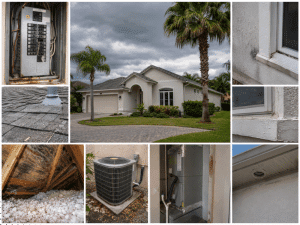
Panels from the 1970s and 1980s, including brands with documented performance concerns, remain in service in many Pinellas County homes. An outdated or undersized electrical panel is not just a safety issue — it is an insurance issue. Several Florida carriers will not write a policy on a home with certain panel types, or will require replacement before binding coverage.
Roof age and condition.
This is the single most insurance-sensitive finding in any Florida home inspection right now. Florida carriers scrutinize roof age closely — some will not insure a roof over 15 years old, and others will require a roof certification or replacement. Your inspector documents roof material, estimated age, visible wear, flashing conditions, and any existing damage. That documentation is what your insurance agent needs to shop coverage accurately.
Moisture intrusion and stucco conditions.
Clearwater’s gulf-side humidity and the driving rain that comes with summer storms create consistent pressure on exterior stucco, window perimeter seals, and soffit penetrations. These are the areas where moisture infiltration starts — often invisibly — and where it accelerates in hurricane season. A thorough inspector checks inside the attic above suspect areas, not just the exterior surface.
HVAC condition and age.
Systems in the 12-to-18-year range are common in Pinellas County’s 1990s–2000s construction stock and are approaching end of useful service life. An HVAC replacement in Clearwater costs between $6,000 and $14,000 depending on system size and configuration. That is a real negotiating number if your inspector documents an aging unit under load.
Why August Conditions Matter for Your Inspection
August is peak hurricane season in the Tampa Bay area. For a home buyer, that is not a reason to delay — it is a reason to inspect more carefully. Here is why this timing actually works in your favor.
Florida’s rainy season runs June through September, with August historically producing some of the highest monthly rainfall totals in the Tampa Bay area. That means your inspector is looking at a home that has been saturated, tested by convective storms, and subjected to the kind of conditions that expose latent defects that dry-season inspections simply miss.
Standing water or evidence of poor drainage in the yard after recent rain is visible on inspection day in August in a way it is not in February. Roof flashings that have been through months of sun and rain show more evidence of wear. HVAC systems running in 90-plus-degree ambient temperatures are under real load — a system that borderline functions in mild weather may reveal its limits when it is actually working.
The Tampa Bay housing market correction also plays directly into buyer strategy this August. Inventory in Pinellas County has risen meaningfully compared to the frenzied market of 2022. Sellers who priced aggressively into a slower market are more likely to negotiate on findings. Your inspection report is not just a document — it is a negotiating tool. A well-documented list of findings from a credentialed inspector gives you options: request repairs, request a price reduction, or walk away with your earnest money intact if the findings are material.
Flood Zones, Insurance, and the Facts Buyers in Clearwater Need
Pinellas County is one of the most flood-exposed counties in the United States. Much of Clearwater, St. Petersburg, and the surrounding barrier island communities sit in FEMA-designated flood zones ranging from AE (high-risk) to X (lower-risk). The flood zone designation of the specific property you are buying determines whether you are required to carry flood insurance — and at what cost.
Your home inspector is not a flood zone certification service, but a thorough inspector flags physical evidence that is flood-relevant: water staining at the base of interior walls, efflorescence on block foundation walls, evidence of prior moisture damage in mechanical closets, and the condition of the sump pump or French drain system if present. These physical signals, combined with FEMA flood map data your agent or attorney can pull, give you a complete picture of the property’s flood exposure.
Florida’s property insurance crisis is not abstract in Pinellas County — it is a practical closing-table issue. Multiple major insurers have exited the Florida market since 2021, and Citizens Property Insurance (the state’s insurer of last resort) has implemented stricter eligibility rules. The practical result: insurance agents are declining or pricing out properties with older roofs, older electrical systems, and documented deferred maintenance. Buyers who close without understanding what their inspector found have arrived at the insurance conversation unprepared. Buyers who attend their inspection and read the report carefully arrive knowing exactly what they are working with.
Buyer Strategy: How to Use Your Inspection in the Current Pinellas County Market
In the Clearwater market right now, inspection contingencies are back on the table. After years in which buyers waived inspections to compete, the current pace of the Pinellas County market allows most buyers to negotiate without that risk. Do not give that protection away.
Schedule your inspector as soon as your offer is accepted. In the Tampa Bay area, standard inspection windows run seven to ten days. Use all of it if you need to. If your inspector flags the roof, the electrical panel, or the HVAC system as needing further evaluation, you have time to bring in a licensed specialist for a second look before your contingency expires.
After the inspection, work with your real estate agent to structure requests based on what the findings actually cost — not what is emotionally alarming. A roof with ten years of remaining life but visible granule loss is a negotiating point. A roof with three years of remaining life at best is a different conversation. Your inspector’s documentation of the difference is what makes one argument or the other credible.
If the seller responds to your inspection findings with a repair credit rather than a repair, make sure you understand what the credit covers. In Clearwater’s current market, a partial credit on a roof that a carrier may not insure is not the same as a roof that actually qualifies for coverage. Your inspector can help you understand the distinction.
Questions Clearwater Home Buyers Ask About Inspections
Q: Why does roof age matter so much for Florida homeowners insurance in 2026?
Florida homeowners insurance carriers use roof age as a primary underwriting factor because roofs are the most common source of catastrophic loss claims in the state. In Pinellas County, several carriers will not write a new policy on a home with a roof over fifteen years old, and others require a roof inspection certification before binding coverage. If your home inspector documents a roof that is fifteen years or older, your insurance agent needs that information before you close.
Q: What does a home inspector look for in a Clearwater FL home that is different from other markets?
A Clearwater home inspector pays specific attention to Florida-climate conditions that inspectors in other regions rarely encounter: roof damage from UV exposure and wind-driven rain, moisture intrusion at stucco and window perimeters, HVAC performance under sustained high heat and humidity load, electrical panel age and type relative to Florida insurer requirements, and physical evidence of water exposure in the lower portions of interior walls and mechanical spaces. These are the findings that most directly affect insurability and true cost of ownership in Pinellas County.
Q: Does a home inspector check flood zone risk in Clearwater?
A home inspector does not determine or certify a property’s FEMA flood zone designation — that comes from FEMA’s Flood Map Service Center or a licensed surveyor. However, a thorough inspector identifies physical evidence consistent with prior water intrusion or moisture exposure at the base of walls, foundation areas, and mechanical spaces. That physical evidence, combined with the property’s mapped flood zone designation, gives buyers a complete picture of flood-related risk before they close.
Q: How does the Tampa Bay housing market correction affect the inspection process for buyers?
The slowdown from the 2021–2022 peak has meaningfully shifted negotiating leverage back toward buyers in Pinellas County. Sellers who priced into a competitive market and are now sitting on inventory are more likely to negotiate on documented inspection findings. A detailed, photo-documented inspection report from a credentialed inspector is the foundation of that negotiation — it converts subjective impressions into documented, priced findings that support a repair request or a price reduction.
Q: Is August a good time to get a home inspection in Clearwater?
August is actually one of the most revealing times of year to inspect a home in Clearwater. Florida’s rainy season peaks in summer, which means drainage patterns, moisture vulnerability at the exterior, and HVAC performance under sustained heat and humidity are all visible under real-world conditions. Latent defects that stay hidden during a dry-season inspection are more likely to surface in August. The hurricane season timing does not create inspection problems — it creates inspection clarity.
Schedule Your Clearwater Home Inspection With SEC Inspection Services
SEC Inspection Services serves home buyers, sellers, and real estate professionals throughout Clearwater, St. Petersburg, Largo, Dunedin, and Safety Harbor — the full Pinellas County market.
Dan Menikheim delivers thorough, photo-documented inspection reports that give buyers the information they need to negotiate, make informed insurance decisions, and close with confidence in any market condition.
Ready to schedule? Call SEC Inspection Services at 727-992-7723 or book your inspection online.
